
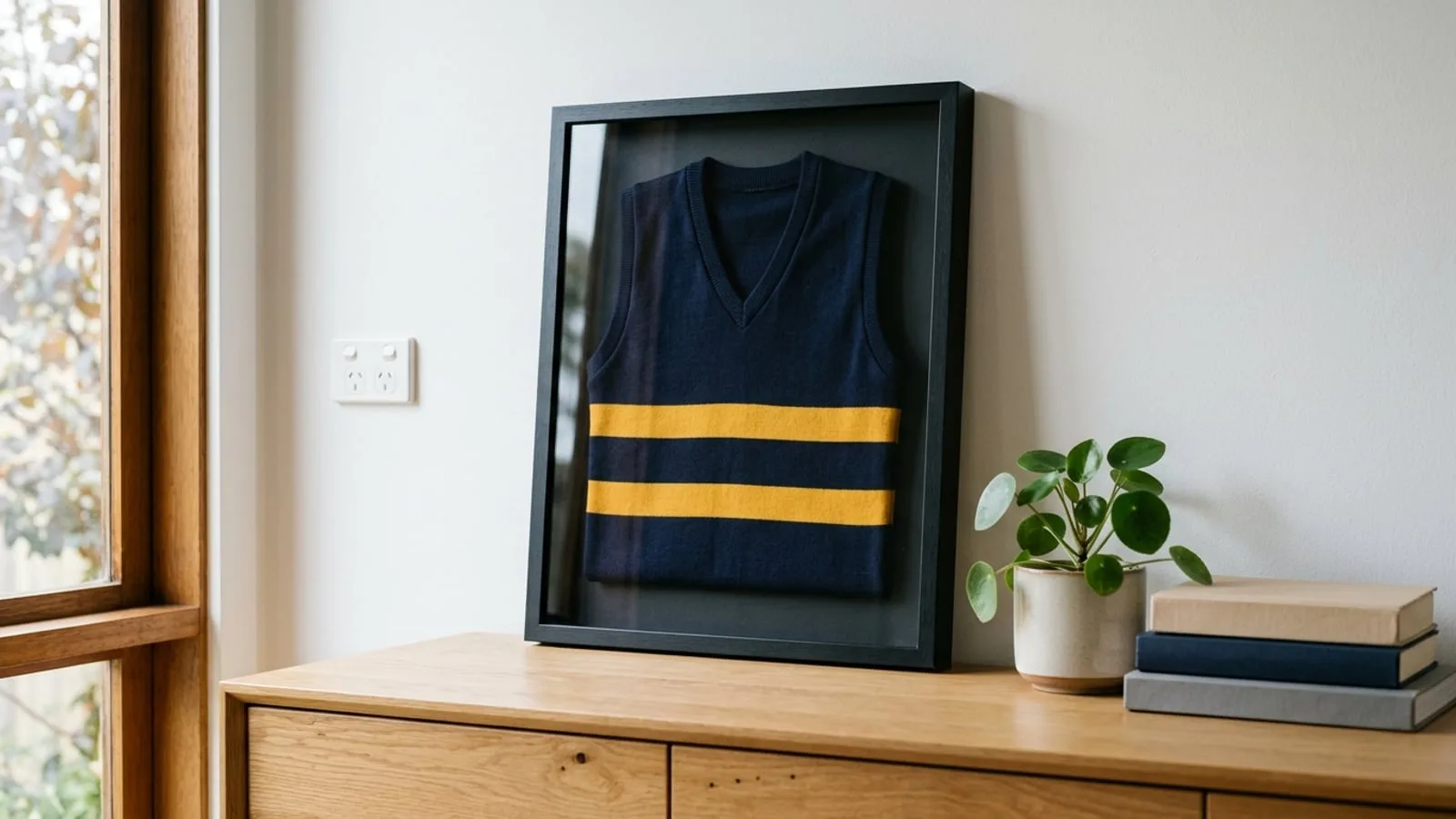
Good jersey framing holds the shirt in a deep frame without glue, staples or pins, keeps the fabric off the glazing and puts UV-filtering glass or acrylic in front of it. Then the frame goes on a wall the sun never reaches. Get those basics right and a signed league jersey or an old club jumper will keep its colour far longer than one pinned up in a sunny room.
With the footy season heading towards finals, plenty of jumpers come out of the cupboard. Some are signed, some belonged to a grandparent and some are a child’s first team shirt. Each one deserves better than drawing pins on a bedroom wall.
Why a jersey needs a deeper frame than a print
A shirt is a three-dimensional object. Collars, seams, embroidered badges and folded sleeves all add thickness, so the frame needs enough depth for the fabric and its backing without anything pressing on the glazing. That is why jersey framing starts with depth: a frame that is too shallow flattens the shirt against the glass or acrylic. Ask for enough depth that the glazing clears the thickest part of the shirt, which is often the collar or a stitched badge.
A frame also spreads the shirt’s weight across a flat, supported backing instead of leaving it to hang from a nail or a hook. The Australian War Memorial’s textile advice puts the principle simply: the key to good handling and storage is support.
How a jersey is held in place without glue or pins
The Memorial’s conservation advice on textiles says items should go into frames without the use of staples or adhesive. It adds that a textile conservator can recommend a reversible way to sew or mount a textile and can work with a framer on the result. A careful mount usually holds the shirt on a padded, fabric-covered board with a few fine stitches, so it can come out later without damage.
The backing fabric matters as well. The Memorial recommends cotton or polyester for covering backing boards, and it warns against wool, felt in particular, and silk as backing materials, noting that wool attracts insects. Soft, padded folds are kinder than sharp creases, which its storage advice says can split fabric along the fold line.
Deciding how the jersey will be laid out
Before the framer starts, decide what you want to see. Sleeves spread wide show the whole shape of the shirt but need a much bigger frame, while a folded layout keeps the number, the club badge or the signatures front and centre on a smaller wall. If the shirt is signed, make sure the folds and stitches stay well clear of the signatures.
Some people add a match ticket, a team photo or a small plaque in the same frame. Paper and photos need the same protection as the fabric, because the State Library of Queensland counts textiles, photographs and works on paper among the items that are extremely sensitive to light.
Choosing glazing for jersey framing
The glazing should never touch the jersey. The State Library of Queensland’s guide to matting and framing says glazing should never come into direct contact with the framed object and suggests spacers or a mat window to keep it clear. For a shirt, a deep box frame with spacers does the same job.
Both glass and acrylic come with UV filtering, which the same guide says helps reduce fading, and the Memorial suggests UV-filtering Perspex for framing textiles. Acrylic weighs less than glass and is shatterproof, a real plus on a large, heavy box frame. If you’re weighing the two up, our comparison of acrylic and glass for picture frames runs through the trade-offs.
Where to hang a framed jersey so it doesn’t fade
Light is the biggest risk once the jersey is on the wall. The Memorial says light damage can cause fading, colour changes and weaker fibres, and that the damage is accumulative and non-reversible. It advises avoiding any exposure to sunlight, because sunlight carries a high proportion of ultraviolet light, the most damaging part of the spectrum.
Pick an inside wall that direct sun never reaches, away from heaters, fireplaces and exhaust vents, as the Queensland guide recommends. Don’t fit a light inside the frame either, because the Memorial points out that lights also give off heat. Even careful jersey framing can’t undo light damage, so for a shirt that really matters, consider putting it on show for big occasions and storing it flat, in the dark, the rest of the time.
Getting a jersey ready for framing
Start with a clean shirt. Clean textiles are less attractive to insects such as carpet beetles and clothes moths, according to the Memorial. Take out safety pins, dry-cleaning tags and anything metal before the jersey goes to the framer.
If the jersey is old, fragile or signed, don’t wash, spot clean or iron it yourself. The Memorial leaves washing and spot cleaning to a trained textile conservator, and it says ironing speeds up deterioration and can set some stains. Bring it to the framer as it is, folded loosely with acid-free tissue in the folds.
Write down the jersey’s story while you still remember it: who wore it, who signed it and when. A note fixed to the backing board travels with the frame and will mean a lot to whoever inherits it.
What else our mobile framing service can frame
Memorabilia framing is part of our mobile framing service, along with certificates, canvases, posters and prints. The service includes a free framing consultation, where we can talk through mounting boards and protective glass options with you. We then collect the piece, frame it and bring it back finished.
To ask about jersey framing in Newcastle, Sydney, Melbourne or Brisbane, start with our picture framing service. Tell us how many pieces you’d like framed and their rough size, and we’ll put together a free quote.