
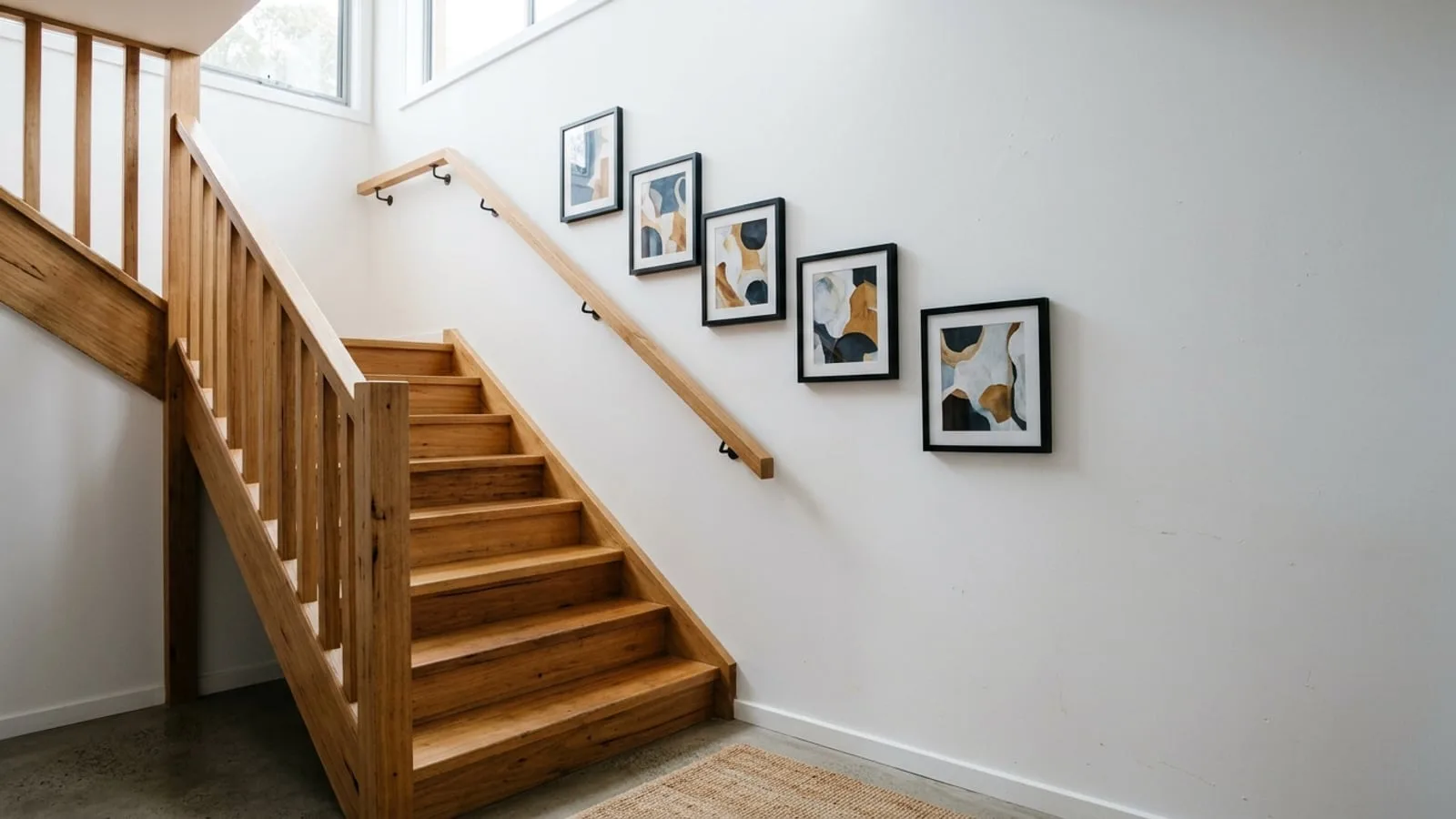
Hanging art on stairs works when every piece sits at the same height above the step directly below it, so the whole arrangement rises at the same angle as the staircase. Keep the frames well clear of the handrail, fix them so a passing shoulder cannot knock them crooked, and never stand a stepladder on the treads to reach the high spots.
A stairwell is often one of the tallest walls in a house, and a spare weekend at the end of winter is enough time to plan it properly. It is also the hardest wall to measure and the most awkward to reach, which is why the plan matters more here than anywhere else.
Measure each piece from the step below it
On a flat floor, the usual approach is to centre a picture at eye level, and our guide to what height to hang pictures walks through the measurement. On a staircase the floor keeps changing, so take that same measurement from the nosing of the step directly beneath each piece.
Do this for every frame and the centres will line up along a slope parallel to the stairs. To check before drilling, run a strip of masking tape from the centre mark of the lowest piece to the centre mark of the highest, then look at it from the bottom of the flight and from the landing. Any frame that sits above or below the tape will be obvious.
Landings break the pattern. Anything hung on a landing wall goes back to the flat-floor measurement, and the sloping line starts again from the first step of the next flight.
Keep frames clear of the handrail
If the handrail runs along the wall, it sets the lower limit. Under the housing provisions of the National Construction Code, the top surface of a stair handrail must sit at least 865 mm above the nosings of the treads, so the bottom of each frame needs to sit comfortably higher than that line.
Leave room for a hand sliding up the rail as well. Frames that hang low enough to brush knuckles or a sleeve will be knocked often, and the lowest corner of each frame takes most of the damage.
Choose a layout for hanging art on stairs
Straight flights suit a single line of frames rising with the stairs, either all the same size or mixed sizes that share a common centre line. A wider stairwell can take a stepped grid, where rows of matching frames climb together like the treads.
Spacing along a slope is simpler than it looks. Keep the same horizontal gap between neighbouring frames, measure every centre from its own step, and the rise between pieces will follow the stairs without any extra maths.
If the stairs turn at a landing, the landing wall is a natural home for one larger piece, with smaller works leading up to it. Narrow stairs call for restraint, because deep frames make a tight space feel tighter and catch anyone carrying a laundry basket.
Secure every frame against knocks
Stairs are a busy route through the house, so hanging art on stairs means planning for bumps. Two fixing points per piece stop a frame swinging off level, and small bumpers at the bottom corners of each frame stop it rattling against the wall.
Heavier pieces need extra thought, because a frame that falls here lands on a step where someone may be standing. Fix them into the frame of the wall or into solid masonry rather than relying on plasterboard alone, and check them now and then for movement. Stairwells often have light switches at the top and bottom of the flight, so check for cables before drilling anywhere near them.
In a busy household, a security fitting that locks the bottom of the frame to the wall stops a piece lifting off its hooks when a bag or an elbow catches it. It also keeps the line straight between visits with the spirit level.
Reach high stairwell walls without a fall
Ladders are the real hazard in a stairwell. The ACCC’s ladder safety guide says that on average more than 30 Australians, mainly men, die each year after falling from a ladder.
Its safety advice is to set a ladder up on a firm, flat surface with the spreaders locked, have another person hold it, keep your body centred between the side rails and never stand above the second step from the top of a stepladder. Stair treads cannot give a standard stepladder that firm, flat footing. The high section of a stairwell needs a ladder or platform designed for stairs, or someone who works on stairwells regularly.
Resist building a platform from a plank and two ladders. One of the falls described on that same ACCC page happened from exactly that kind of set-up, and a stairwell adds a drop down the flight to the risk.
Check the view from the bottom and the landing
People see stair art while climbing, coming down and from the hallway below, so look at each position from all three before you drill. Have a helper hold the piece in place while you step back down the flight.
Watch the windows too. Museums & Galleries of NSW warns about reflections on framed works and direct sunlight on works on paper wherever there are windows, and a glazed frame opposite a stair window can turn into a mirror at certain times of day.
Check again after dark. A downlight or wall light near the stairs can throw glare across glass or leave a frame in shadow, and it is easier to shift a piece a little before the holes are drilled than after.
Getting help with a tall stairwell
Handling very large and heavy artworks in tight spaces such as stairways and hallways is a speciality of our team. If hanging art on stairs at your place means working high above the treads, see our art hanging services and ask for a quote for the whole flight.