
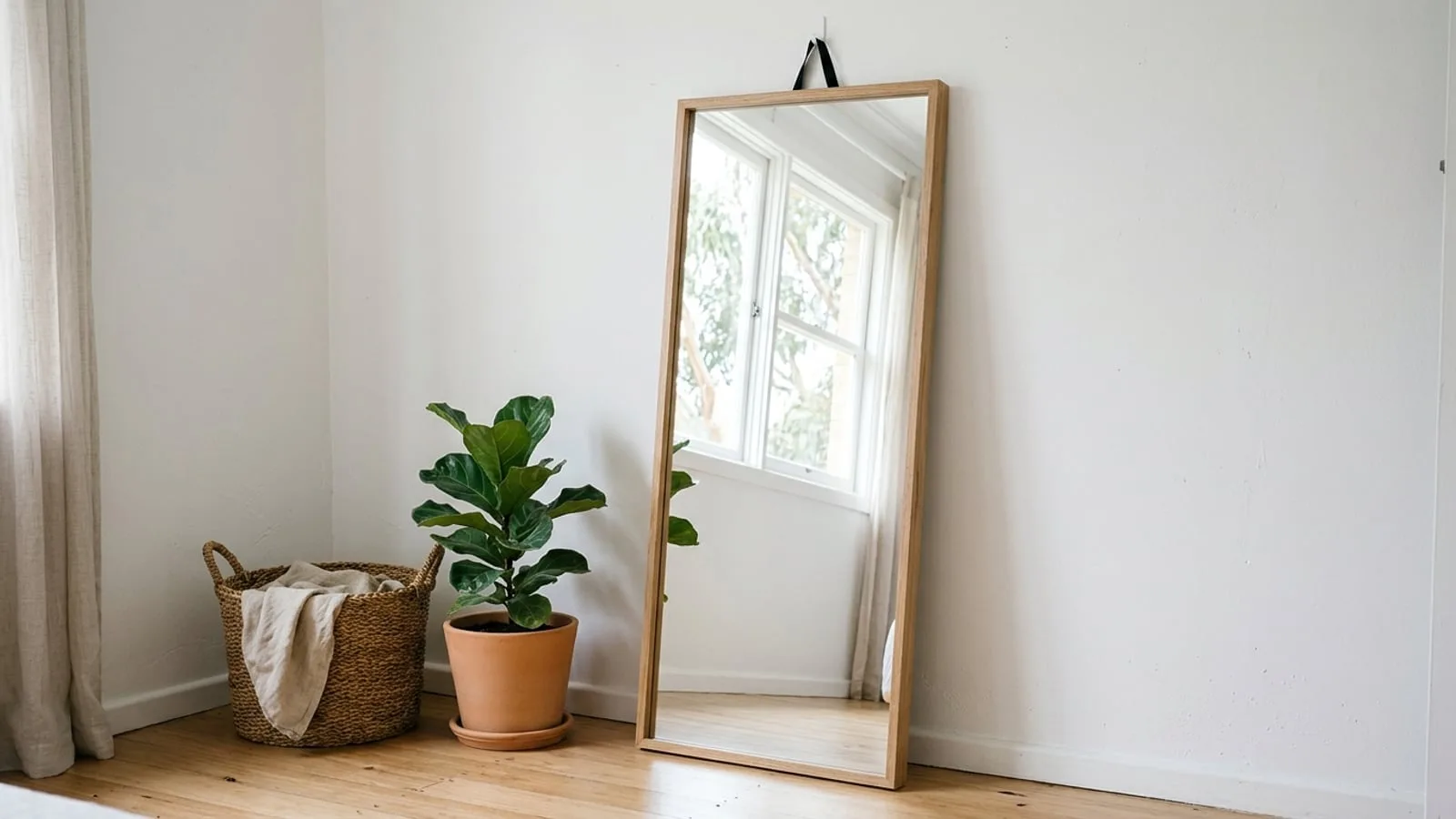
A leaning mirror is safe when it can’t slide at the base or tip forward at the top. For a large floor mirror, that means a stable floor, a grippy base and a strap or bracket tying the top of the frame to the wall. In a home with toddlers or a boisterous dog, hanging the mirror properly is usually the safer choice.
Full-length mirrors propped against a wall look relaxed, and that’s the appeal. The catch is that a tall pane of glass in a heavy frame is held up by nothing more than friction and an angle.
Why a leaning mirror slides or tips
A leaning mirror stays put only while its weight presses back against the wall. Stand it too upright and a small bump at the top can tip it forward. Lean it too far and the base can skate out across polished timber, tiles or a slippery rug.
Carpet brings its own problems. The ACCC’s guide to toppling furniture and TVs says furniture is more unstable on soft or uneven surfaces such as carpet or a rug, and that carpet can become thicker and more uneven at the wall’s edge. Mirrors aren’t on its list, but a mirror’s base sits in exactly that spot.
Who is most at risk around a large floor mirror
Small children are the main worry. The same guide says children under five are most at risk of serious harm from toppling furniture or TVs, and warns that something can look stable yet topple if a child pushes or grabs it. A tall mirror at a toddler’s eye level is a very tempting thing to grab.
Glass adds a second hazard. If a mirror falls, broken glass becomes a danger on top of the weight itself, which is why the glass is worth a thought when you buy. Pets, robot vacuums and busy hallways round out the list of things that bump into mirrors.
How to anchor a leaning mirror to the wall
The fix is the one the ACCC gives for furniture: the best way to prevent tipping is to secure it to the wall or floor. For a mirror, that means a short strap, cable or bracket fixed to the top of the frame and to the wall behind, set so the mirror keeps its lean but can’t come forward.
Fix the wall end into a stud, or into masonry with a plug that suits it, once you have checked the spot for cables. The guide’s point that the right anchor depends on the wall material applies here too, and it suggests asking at a hardware shop or asking a tradesperson if you’re not sure. On the frame side, screw into solid timber rather than a thin backing board.
At the base, non-slip rubber pads stop the bottom edge skating and protect the floor. Check the carpet where the mirror will stand, and move it if the pile bulges up against the skirting board.
Check the mirror’s weight before you choose the hardware. A heavy mirror needs a strong strap or bracket and a fixing into solid timber or masonry, not a light plasterboard plug.
Where a large floor mirror should stand
Placement does a lot of the safety work. Keep a floor mirror out of the main walking line, away from doors that swing towards it and out of the corner where children play. A spot beside a wardrobe or at the end of a bed is usually calmer than a busy living area.
In a narrow hallway there is nowhere for a bump to go, so a wall-hung mirror is the better choice there.
Renting? Talk to your landlord before you drill
Many renters skip anchoring because they worry about holes. The ACCC’s advice for tenants is to talk to the landlord or agent about installing anchor devices, explain why, and let them know you’ll remove them at the end of the tenancy. It also notes that Western Australia, New South Wales and Victoria have laws that make it much easier for tenants to secure furniture to the wall for safety reasons.
A mirror may not count as furniture under those rules, so ask rather than assume. Our post on hanging pictures in a rental covers the options when you can’t drill freely.
When hanging the mirror is the better choice
If the mirror is heavy or small children live in the house, take it off the floor and hang it. A mirror fixed to the wall at two points, into studs or masonry, is far harder to pull over, and it frees up floor space. Our article on mirror weight and wall load limits explains how both shape that decision.
Our team has extensive experience with very large mirrors, which is worth knowing if yours is too heavy to lift safely on your own.
Ask whether the glass has a safety backing
Some mirrors are made with a film bonded permanently to the back of the glass. Viridian, an Australian glass manufacturer, describes its vinyl-backed safety mirror as a Grade A safety product that is ideally suited to wardrobe doors and full height mirrors. If you’re buying a full-length mirror for a child’s room or a busy hallway, ask the retailer whether the glass has a safety backing.
A safety backing doesn’t replace anchoring. Think of it as a second layer of protection for a leaning mirror, in case something goes wrong anyway.
If you’d like a big mirror fixed to the wall rather than propped against it, our mirror hanging team covers the Gold Coast, Byron Bay, Newcastle, Brisbane, Sydney and Melbourne. When you get in touch, include your suburb, the mirror’s rough size and weight and the wall type so we can quote accurately.