
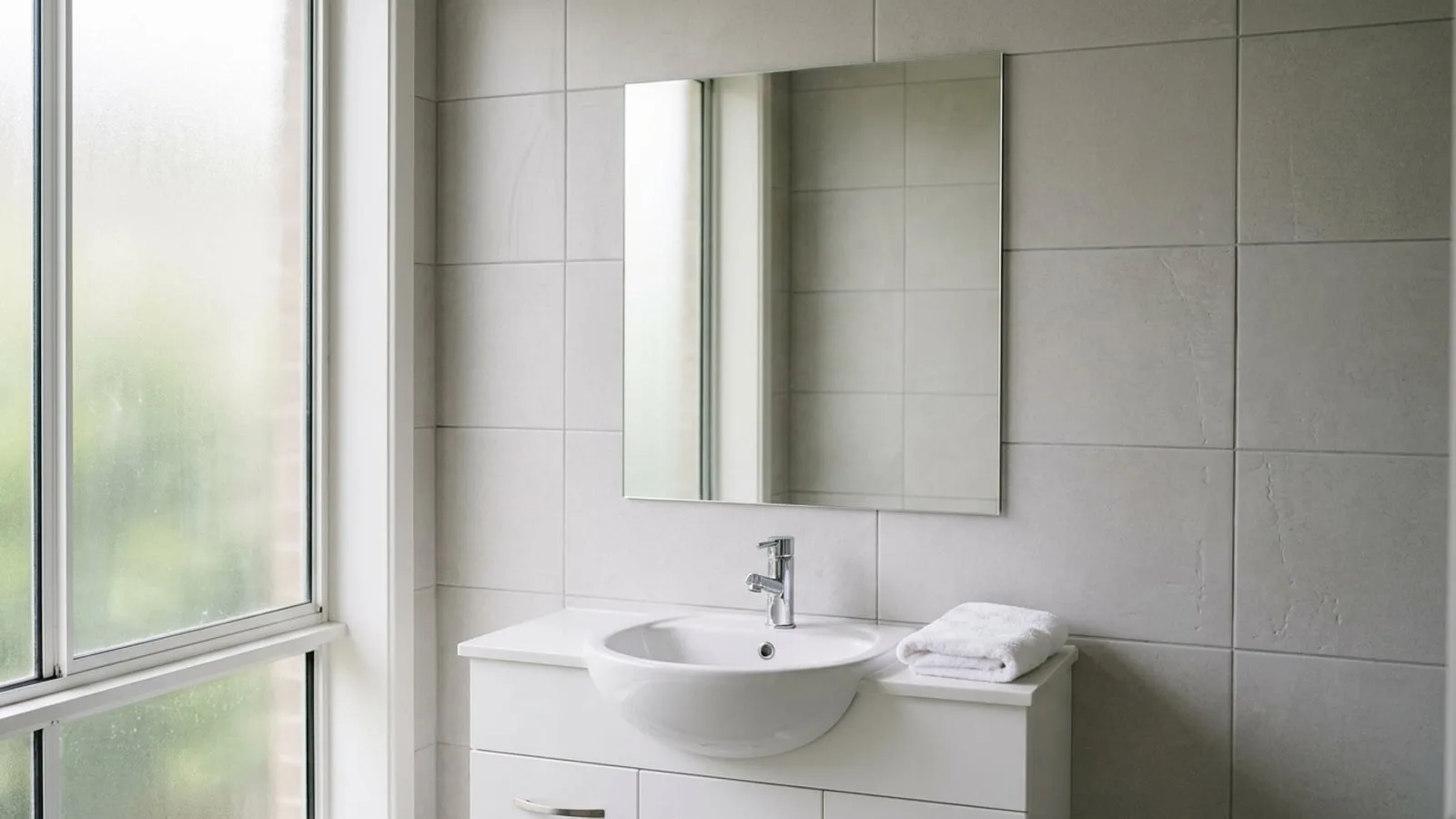
You can hang a mirror on tiles safely by drilling through the tile into the wall behind it, using fixings that suit that wall and keeping every hole out of the shower’s waterproofed zone. Above the vanity is usually the easiest place, as long as you check for pipes and cables first. A mirror glued straight onto tiles is a different job and is best left to a glazier.
Winter is when a bathroom works hardest. Hot showers fill the room with steam most mornings, and the mirror and its fixings live with that moisture every day, so the details below matter more here than in a living room.
Find out what is behind the tiles
Tiles are only a surface. Before you hang a mirror on tiles, work out what the screws will actually grip, because it will be either a sheet lining fixed to a timber or steel frame, or solid brick or concrete.
Our usual advice for any wall works here too: knock on it. A hollow sound points to a sheet wall, and a solid feel points to brick or concrete. In a bathroom, the sheet behind the tiles may be fibre cement or water-resistant plasterboard rather than ordinary gyprock.
An older bathroom needs one more check before you drill. The NSW Government’s asbestos safety site estimates that 1 in 3 NSW houses built or renovated between 1945 and 1990 contain asbestos, lists behind tiles among the common places it turns up and warns that even drilling to hang a picture can expose it. If your bathroom could date from those years and you don’t know what the backing sheet is, have a licensed asbestos assessor check it first.
On a sheet wall, a heavy mirror should be fixed into the frame behind it or held with fixings rated for hollow walls. On masonry, drill deep enough that the plug expands inside the wall rather than inside the tile, where it can crack the tile. Our guide to the heaviest mirror you can hang on a wall covers weight and wall strength in more detail.
Keep holes out of the shower’s waterproof zone
Behind the tiles of a shower there should be a waterproofing layer, and the National Construction Code’s housing provisions are specific about it. They say the walls of the shower area must be waterproof to at least 1800 mm above the floor substrate, and that penetrations within the shower area must be waterproof.
A screw driven through the tiles in that zone punches a hole in the membrane. Water can then find its way behind the tiles, out of sight, long before anyone notices a problem. That’s why any wall inside the shower area is best treated as off limits for mirror fixings, and older bathrooms deserve the same caution, because you can’t see a membrane through tiles.
The rules around a basin are lighter. Walls only need to be water resistant to at least 150 mm above a basin that sits within 75 mm of the wall, and the fixings for a vanity mirror normally sit well above that height. Splashes still reach them, which is one more reason to choose hardware that won’t rust.
Check for pipes and cables before you drill
Bathroom walls are busy. Cables run to vanity lights, exhaust fans, heat lamps and power points, and water pipes feed the basin and shower mixers. NSW electricity distributor Ausgrid advises that you check for wires before drilling into walls, because a metal drill that touches concealed wiring can give you a shock, and that you take particular care around power points and light switches.
Avoid drilling directly above or below a tap, switch or power point, since pipes and cables often run straight up or down from them. A detector can help, but treat its reading as a guide, not proof. Ausgrid also recommends a portable safety switch whenever you use power tools.
How to hang a mirror on tiles without cracking them
Mark the spot on a strip of masking tape so the bit doesn’t skate across the glaze. Use a bit made for tiles, switch the hammer action off and start slowly with light, steady pressure. Porcelain is much harder than ceramic, so expect it to need a diamond bit and some patience.
Let the bit cool every so often and keep the hole well away from the edge of the tile, where cracks start most easily. Drilling through a grout line is tempting because the hole is easier to patch later, but it limits where the mirror can go. Once you’re through the tile, switch to a bit that suits the wall behind it.
Choose fixings that won’t rust in a damp room
Steam and splashes are hard on ordinary screws, and a rusting fixing stains the grout and loses strength over time. Whichever way you hang a mirror on tiles, choose stainless steel or other corrosion-resistant screws and hardware. When we hang mirrors, we secure them with quality fastenings that won’t corrode.
A framed mirror should hang from two points, such as a D-ring on each side, rather than one wire over one hook, so it can’t tilt or slip. Frameless mirrors are held with mirror clips, a channel or adhesive, and a glued mirror is a glazier’s job. Skip adhesive strips and stick-on hooks in a bathroom. We don’t install adhesive hooks, because they can fail.
Care for a bathroom mirror once it’s up
Viridian, the Australian glass maker, keeps its mirror cleaning advice simple: apply a few drops of solution with a clean, damp, lint-free cloth and keep moisture away from the mirror’s edges. Its guide also warns against abrasive cleaners and against products containing hydrofluoric or phosphoric acid.
In practice that means a light touch with the cleaner rather than a generous spray, and drying the bottom edge after a steamy shower. Leave a small gap between the mirror and the vanity top or splashback so water can’t sit against the edge. Running the exhaust fan during and after showers helps the whole room, mirror included.
Getting help with a large or heavy bathroom mirror
Big vanity mirrors, tight gaps beside a shaving cabinet and walls you can’t identify are the jobs where a professional is worth calling. Our team hangs heavy mirrors on plasterboard as well as on crumbly and uneven walls.
If you’d rather not drill your own tiles, our mirror hanging service works across Sydney, Melbourne, Brisbane, Newcastle, Byron Bay and the Gold Coast. Tell us the rough size and weight of the mirror and what the wall is made of, and we’ll come back with a free quote.