
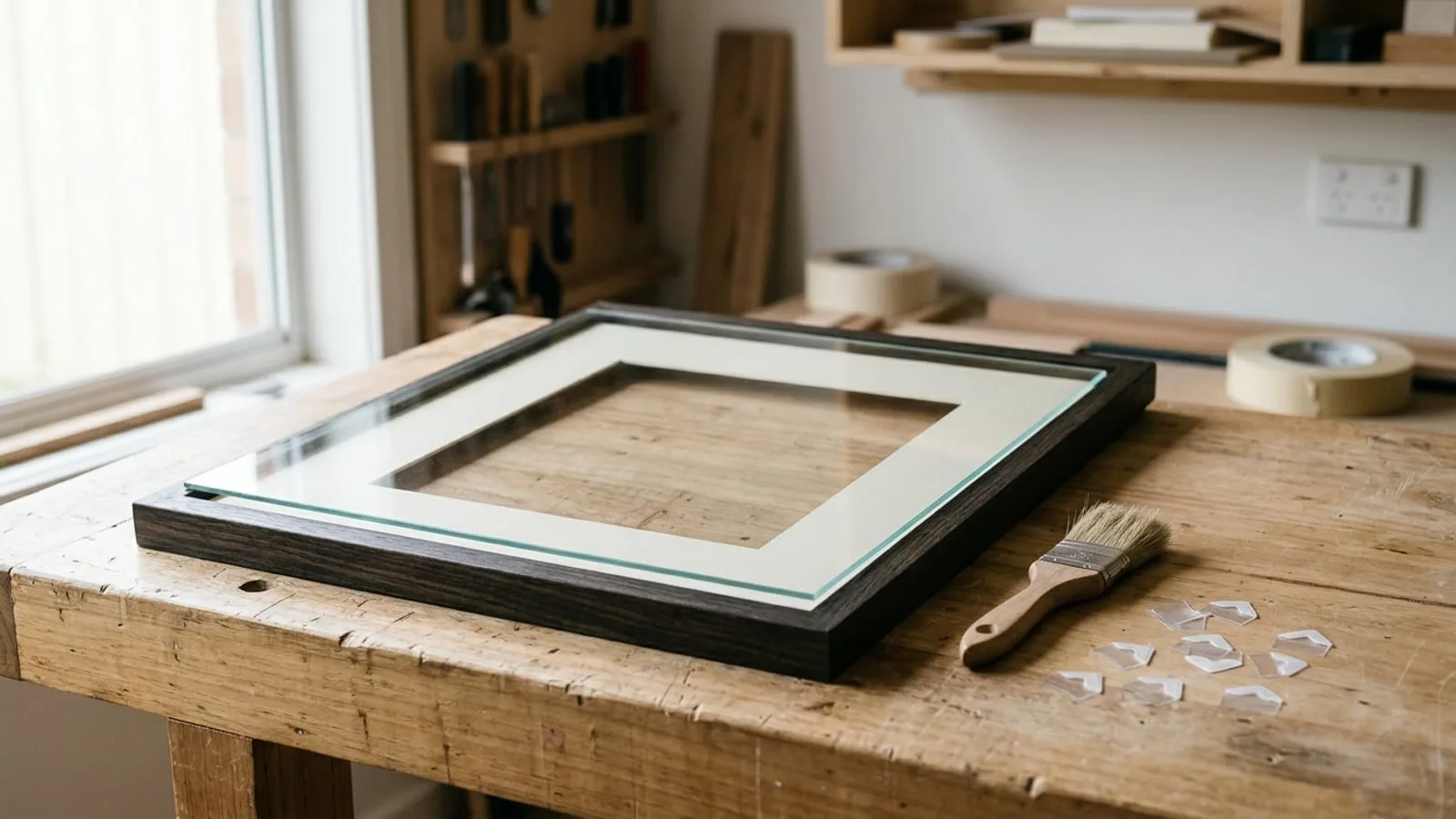
The safest approach to framing old photos is to frame a good copy and keep the original stored flat in a box. If the original does go on the wall, what sits inside the frame does most of the protecting: an unbuffered rag mount, photo corners or tissue hinges instead of tape, a window mount or spacer that keeps the print off UV-filtering glazing, and a sound, well-sealed backing. Those layers slow the damage, but no frame makes an old photograph light-proof.
Remembrance Day often brings the family albums out, and the service portraits and old wedding photos inside them deserve care. Many of those prints have already spent decades in frames that did them no favours.
What damages old photos inside a frame
The materials touching a print matter most. The State Library of Queensland’s matting and framing guide says most mat boards used for framing in the past were poor quality and acidic, and as they deteriorate they cause discolouration, mat burn and damage to the framed item. Tape is another culprit, because adhesive tape is very difficult to remove and can stain, tear and buckle the work it touches.
Moisture is the next risk. The library’s guide to caring for photographs says relative humidity above 60% encourages mould and insects, and that the gelatine emulsion on a photo can swell and stick to whatever is touching it, glass included. Very dry air, below 20%, can make emulsions flake.
Light is the third. The same guide says visible as well as ultraviolet light can cause irreversible fading, colour shift and brittleness, so UV-filtering glazing helps but can’t make up for a wall in direct sun.
Frame a copy and keep the original safe
For framing old photos that matter, a copy is the simplest protection. The Queensland library recommends duplicate prints for permanent display, and State Library Victoria suggests displaying copy prints so the original stays safe in storage. A good scan also lets you print the image larger and share it with the rest of the family.
Keep the original flat in a box, in a room towards the middle of the house, where State Library Victoria notes temperature and humidity tend to stay stable through the day. Our post on how to store art has more on keeping pieces safe off the wall.
Choosing a mount that is safe for photographs
When framing old photos, ask for museum quality, conservation style or 100% pH-neutral rag board, as State Library Victoria recommends. Photographs are a special case. The Queensland framing guide says they are alkaline sensitive and should be framed with unbuffered board, and that framing materials should pass the Photographic Activity Test.
How the print is held matters as much as the board. Photo corners, or Japanese tissue hinges with wheat starch paste, can be removed later without harm. State Library Victoria says dry mounting with heat-set tissue is not a preservation technique and should be avoided, and it suggests joining the window mount and backboard with cloth tape.
Backing boards, frames and a sealed package
Behind the mount, the Queensland guide calls for a rigid backing board made of stable, acid-free corrugated board or corflute. Paper-based boards breathe and act as a buffer in humid climates, while plastic can trap humidity inside the frame and is best kept for rooms with steady climate control. In humid coastal cities such as Brisbane, that makes paper backing the safer choice.
The guide also says the backing should be held in with glazier’s points or heavy-duty brackets and the edges sealed with a framer’s tape. For the frame itself, choose metal or well-seasoned timber, because unseasoned wood can give off damaging compounds, and ask for the rebate to be sealed or lined so acid can’t migrate from the wood.
Glazing and spacers for framing old photos
The print must never touch the glazing. State Library Victoria advises a window mount or spacer between photograph and glass for any valuable print, so the surface can’t become stuck to the glass.
UV-filtering glazing comes in both glass and acrylic, and the Queensland guide credits it with helping to reduce fading. For a valuable item it suggests museum-grade glazing with UV filtering, anti-static and anti-reflective qualities, which most good framers can supply.
Once the photo is framed, hang it on an interior wall out of direct sun and away from fireplaces, using D-rings at two points rather than a single wire, which the Queensland guide describes as the ideal.
Reusing an old frame, and signs it is harming the photo
An old frame can be part of a photo’s history. The Queensland guide says old frames may be historically significant, so keep any inscriptions and framers’ labels, and check that the frame is structurally sound before it goes back into use.
Look closely at a photo that has been framed for decades. A brown line where the print meets the mount, yellowing around the edges, spots of mould or a print stuck to the glass are all signs the frame is doing harm, and the guide suggests assessing window mats and frames after 20 to 30 years in any case.
Don’t try to peel a photo off the glass or clean it yourself. State Library Victoria advises against home repairs, because the wrong cleaning solution, adhesive or repair tissue can permanently damage the emulsion, and a trained conservator can advise on the next step.
Handling and labelling old prints
Hold prints by the edges with clean, dry hands, or wear nitrile gloves, which State Library Victoria says protect a photograph better than cotton gloves. Take out metal paper clips and pins before they rust and stain.
To label a print, write gently on the back along the edge with a soft pencil, never a pen or marker. Don’t laminate an original or mend a tear with sticky tape, because both libraries warn about the lasting damage these cause.
Framing old photos with our mobile service
Our mobile framing service frames family portraits and cherished photos, and it starts with a free framing consultation. Once the frame is finished, we can hang it for you as well.
To frame an old photo, or a copy of one, book our mobile picture framing in Sydney, Melbourne, Brisbane or Newcastle. Let us know how many photos you have and roughly how big they are, and we’ll send through a free quote.